


Oh, Georgia!
It was a long trip to Cumming over the course of one night, but it was totally worth it. You see, I’ve decided to try a new travel methodology. Normally, I get to an area and stick around for a while, grabbing counties while I’m there. This leads to compact maps and large blocks of stuff getting done. I’ve also noticed other cachers whose maps are nowhere near as compact as mine, but who have vast numbers of counties just by traveling from point A to point B and hitting every county along the way. I’ve decided to try out that radial approach myself. In this case, I put a spin on it: I traveled out to my farthest point and started there, intending to work my way back toward home. This should save me from being tired at the end of a weekend and having to do the longest drive of the trip. Doing that longest drive first while I have the most energy is definitely something I will consider in the future.
As for the courthouse, I surprisingly like it. They managed the balance between new and aged well, but this is one of those cases where the courthouse is the least important thing about the county.
My goal for the county was to approach the now-defunct (not the modern) town of Oscarville. Oscarville was a Black town of 1,100 people: landowners, farmers, skilled laborers, and families. It had thrived (as much as any Black town in the South could) since Reconstruction, but 1912 was the year that changed. There were three incidents: one a disagreement between a white girl and a Black boy that led to several attempting lynchings of residents and the death of another town’s white sheriff, another involving a white woman accusing two residents of attempted assault which ultimately resulted in the mob beating of a local Black preacher, and a third involving the death of another white woman blamed on two residents and accomplices that resulted in one lynching and two convictions and illegal hangings. Starting after these events, Ku Klux Klan night raids began happening regularly, firebombing the most important community buildings and driving off 90 percent of the town’s population. The ones who couldn’t or wouldn’t leave were mostly landowners who had no other choice than to sell their land for pennies on the dollar. Some sold, but other holdouts wouldn’t leave despite decades of trying to remove them.
In 1956, responding to nearby Atlanta’s need for water, it was decided to build a dam and create a reservoir, and the last remnants of Oscarville were submerged under the waters. Eventually, that reservoir was given a name …
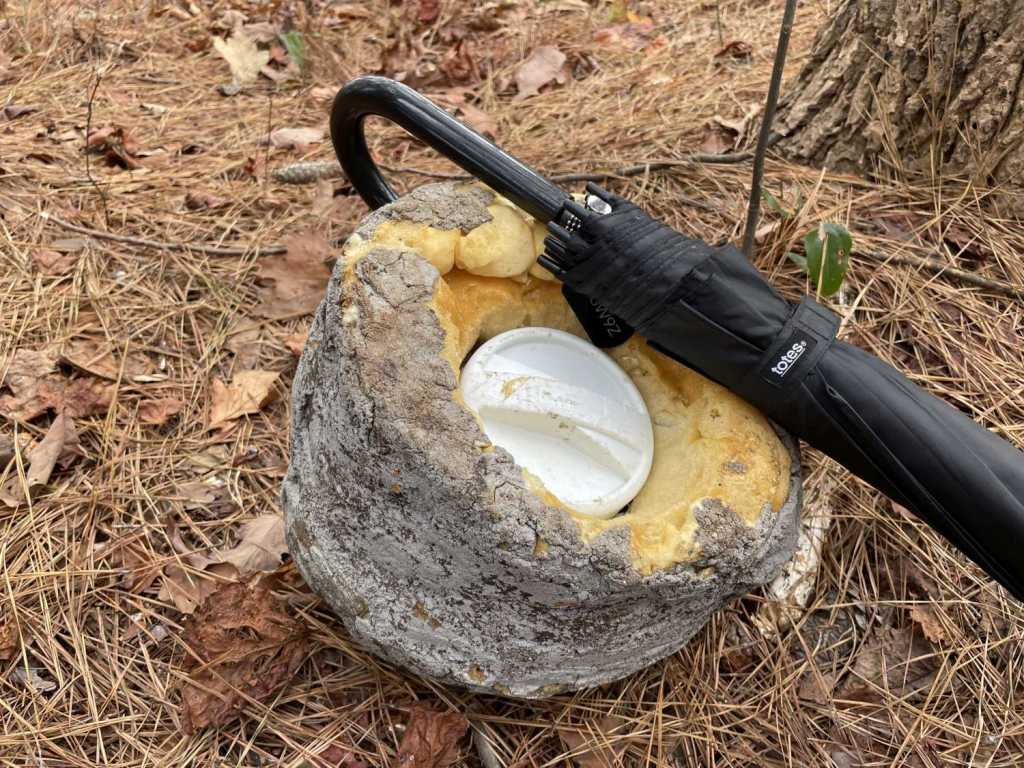
… Lake Lanier.
A number of Black folk are superstitious (some seriously, some sarcastically) when it comes to Lake Lanier. The lake is noted for having two to three deaths a year—more than most other similar riparian features in the area—and that is blamed on the restless spirits of those buried in the now-flooded town cemetery. To quote (though it’s probably more a paraphrase) a comment on the site formerly known as Twitter, “If you tell me that you’re going to Lake Lanier, I’m gonna treat that as a cry for help, and if you invite me to Lake Lanier, I’m gonna take that as a threat.”
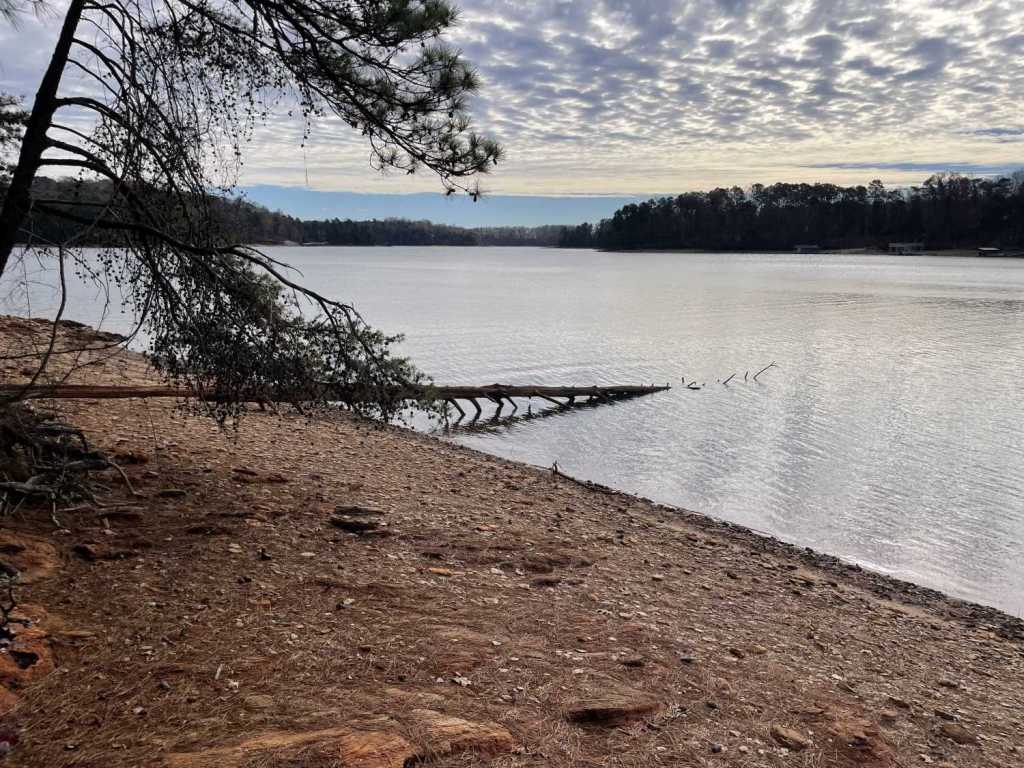
I feel this lake is an interesting metaphor for my entire trip (and even future trips) around the Deep South. History is, quite literally, the narrative one applies to occurrences, including what one chooses to note and what one leaves out. I know a lot of cachers who have gotten Lake Lanier. I bet a good handful of you readers have gotten it, too. But I’m willing to bet that few (if any) of those who have made this pilgrimage knew about Oscarville and how the lake erased it. And that knowledge haunted me as I got the cache. Being down here feels to me like being surrounded by angry ghosts. No, I don’t really believe in the spirits of the dead, but if they were real, what could I possibly do for the souls at the bottom of the lake? No amount of libations or offerings would mean much. It’s not like I have the power to drain the lake. And if I could, who would care for the cemetery then? No doubt most of the descendants of those dead are long gone from here. And how many such spirits would still angrily haunt the Deep South, wronged by deeds long forgotten? I guess my point here (and I do have one) is that this is probably going to be a somewhat different caching trip for me than for most cachers. Sure, I have the goal of caching just like everyone else, but other things are going to come along that many never thought to consider.
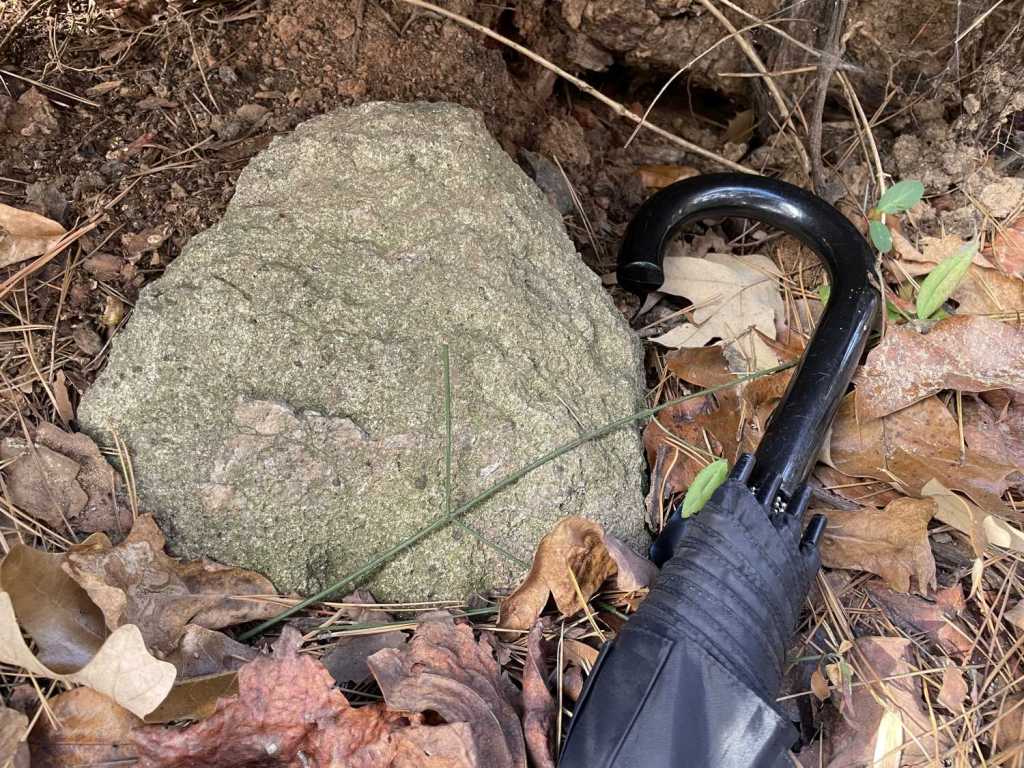
Of course, it’s not all looking into darkness and all that. After fourteen hours of driving, it was a welcome relief to take an extended walk outside. I did a nearby EarthCache about the mica found in the park’s stones. I don’t usually like spending this much time in a county, but this time it was warranted. The cache was special, I needed the time, and the added weight of the moment made it acceptable. I was already prepared for the possibility that it would begin messing up my schedule for the day.
On this trip, other caching methods are changing as well. I’m not remotely afraid of night caching (unless mountains are involved) and have picked up more than my share of counties at some crazy hour of the night. But all my caching while I’m in the Deep South will be daytime only. I know we don’t live in the days of the Jim Crow South or anything, but I’m not taking any chances on being alone in some county in the middle of nowhere down here. If I were traveling with someone, I might reconsider the position. The chances of something going wrong are incredibly low. But if something goes wrong, there’s a non-zero chance that it could go incredibly, extremely, epically wrong. Consequently, I intend to be in a hotel room behind a door by or around sunset. But at least I should get some good nights’ sleep, so there’s that. But sleep would have to wait. Once I was done here, I had to make my next move, and that was to…
 Geocaching While Black
5 thoughts on “881. Cumming, Forsyth County (GA001)”